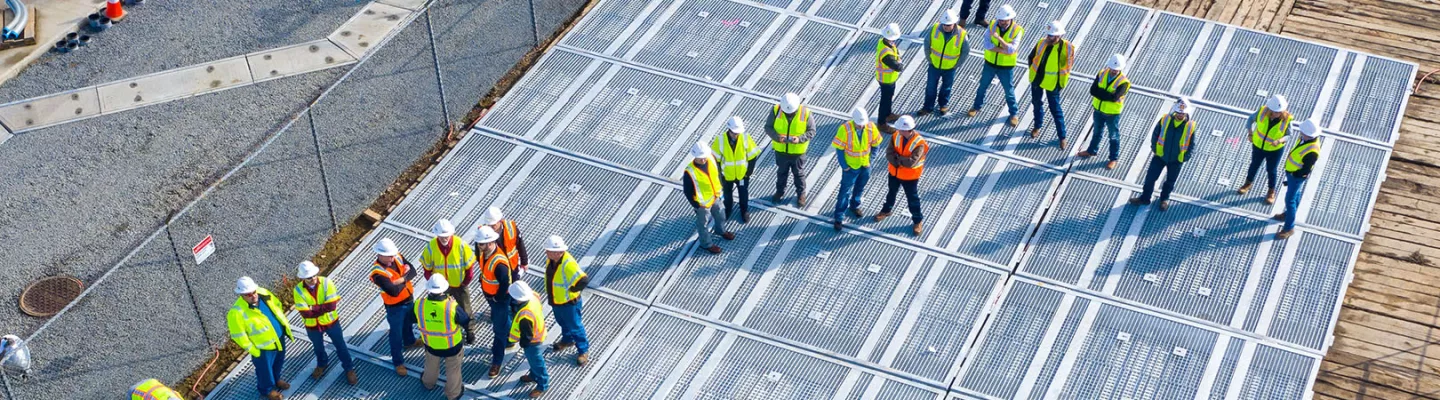
Equipotential grounding using steel EPZ grounding mats is one of the best ways to protect utility workers on the ground from electrical hazards.
Article Updated on: September 25, 2026
Working near energized power lines is one of the most dangerous jobs in the construction and utility industries. According to OSHA, electrocution is one of the top four causes of death in the construction industry, accounting for 8.5% of construction worker fatalities.
Even without direct contact, high-voltage lines can induce an electrical charge in nearby conductive objects, including vehicles and equipment. This creates a serious risk of electric shock or electrocution for workers. To mitigate this hazard, an equipotential zone, or EPZ, is essential. Understanding equipotential grounding is the first step toward creating a safer work environment.
What is an equipotential zone (EPZ)?
An equipotential zone (EPZ) is a designated work area where all conductive objects, including equipment, vehicles and personnel, are bonded together to maintain the same electrical potential. This bonding ensures that if any component becomes energized, the electrical charge is evenly distributed across all bonded components.
As a result, there is no difference in electrical potential between any two points within the zone, which prevents dangerous electrical currents from moving through a worker's body. Effective EPZ grounding is the key to protecting crews from step and touch potential hazards.
The dangers of step and touch potential
When a vehicle or piece of equipment becomes energized, the voltage dissipates into the ground, creating a voltage gradient.
This gradient can lead to two life-threatening scenarios:
- Touch potential: This occurs when a worker simultaneously touches the energized equipment and the ground. The difference in electrical potential between the equipment and the earth causes the current to flow through the worker's body, typically from their hands to their feet.
- Step potential: This happens when a worker takes a step within the voltage gradient on the ground. The difference in potential between their two feet causes the current to flow up one leg and down the other.
Both scenarios can result in severe injury or fatality. To prevent this, equipment must be bonded to a grounding system, which could be a buried ground grid, a ground rod or, ideally, an above-ground EPZ mat. An equipotential zone eliminates these risks by ensuring that the worker, the equipment and the ground beneath them are all at the same electrical potential.
How to create an equipotential zone
Creating a proper equipotential zone involves bonding all conductive objects in the work area to a common point. For temporary job sites near energized lines, this is best achieved with specialized equipment, such as EPZ grounding mats.
Our EPZ mats, made of galvanized steel, are placed on the ground where electrical work will be performed. All equipment, such as aerial lifts or cranes, is then bonded to these mats. When workers stand on the mats, they are at the same electrical potential as the equipment they are operating. If equipment becomes energized, the fault current is safely diverted through the low-resistance path of the mat and bonding cables, away from the worker's body. This protects them from step and touch potential with Grade 5 fault currents.
To maximize the effectiveness of an EPZ and ensure continuous safety, proper implementation is key. This includes strategically placing mats where equipment will operate and workers will be present, conducting regular inspections before each use to check for any damage or wear, and providing comprehensive training to all personnel on the correct setup, use, and understanding of EPZ grounding mats and associated hazards.
Key components for establishing an EPZ include:
- EZP grounding mats: These portable, conductive surfaces serve as the foundation of the EPZ
- Bonding cables: Heavy-duty cables with clamps are used to connect equipment and vehicles to the grounding mats
- Personal protective equipment (PPE): An EPZ provides the primary protection, but appropriate PPE, including voltage-rated gloves and boots, should always be worn
The role of EPZ grounding mats
EPZ grounding mats, also known as grounding grates, are a critical tool for ensuring worker safety in projects involving transmission lines, distribution, substations and renewable energy. They provide a reliable and easy-to-deploy solution for establishing an equipotential zone. By creating a large, conductive surface, they effectively minimize voltage gradients in the immediate work area.
When selecting equipotential grounding equipment, it’s important to choose products that are tested, certified and designed for the specific application, prioritizing high conductivity to ensure effective current dissipation. The mat size, the type of conductive material and the quality of the bonding clamps all affect the effectiveness of the EPZ grounding system.
The United Rentals advantage
United Rentals offers patented EPZ grounding mat rentals that are engineered and tested to meet safety guidelines from organizations like OSHA, KEMA, ASTM, IEEE and more. Made from galvanized steel grates that are bonded together with 4/0 copper cables and 2-hole lug connectors, our EPZ grounding mats are engineered for maximum safety.
Additionally, United Rentals’ EPZ grounding mats can be used on smooth, soft or uneven terrain and won’t shift under moving equipment or materials. These mats are reinforced for tracked vehicles and can withstand up to 100,000 pounds of pressure per foot, providing stability and traction in addition to safety.
A commitment to safety
Working on electrical lines is consistently ranked among the most dangerous civilian jobs. This emphasizes the critical need for companies to adopt a comprehensive safety approach that protects crews and maintains OSHA compliance. It is imperative that job sites involving energized power lines implement equipotential zones to protect workers from electric shock or electrocution.
By understanding and diligently applying these principles, including the use of steel EPZ grounding mats, companies can significantly reduce the risk of electrical incidents, ensuring worker safety and avoiding potentially costly aftermaths.
 Facebook
 X
 Linkedin
 Email
 Print
 Copy Link
 RSS Feed