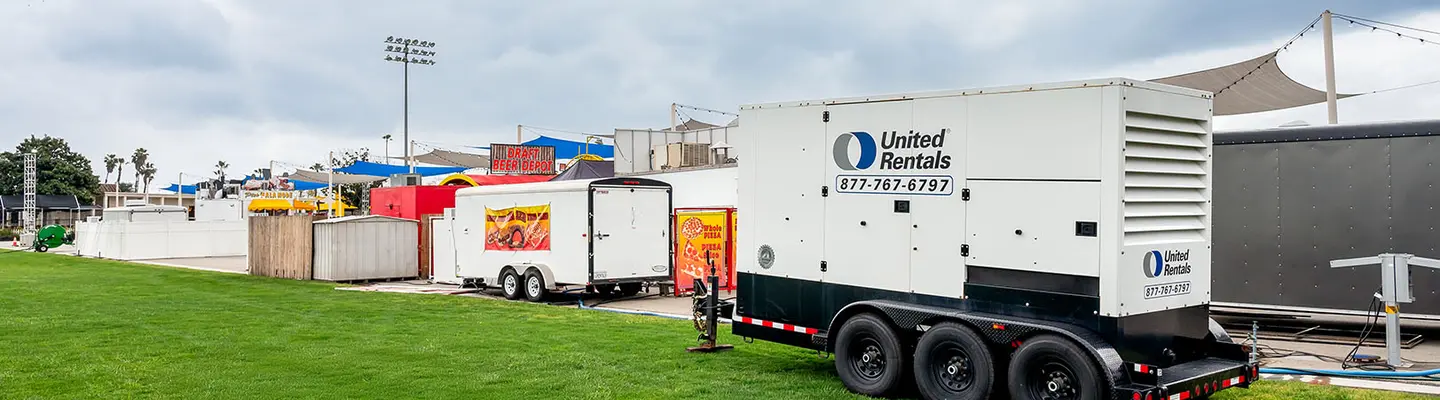
Helpful insights into event power generators and power distribution for events.
Article Updated on: September 29, 2026
Power generators for events bring sound systems, video screens, stage lights, food trucks, outdoor air conditioners and fans to life. But powering an event requires careful planning and no small amount of expertise. This overview of special event power rentals spells out four key steps to successfully planning portable power for large outdoor events.
A knowledgeable temporary power partner can help with load calculations, equipment selection and power distribution planning as well as provide all the equipment needed.
Step 1: How much power does your event need?
Step one is figuring out how much power you’ll need across the whole event. Start by listing everything that requires electricity, including A/V gear (microphones, speakers, video boards, etc.), food trucks, refrigerators, restroom trailers, lights and cooling or heating equipment.
Next, write down the wattage for each asset, which should be listed on the product label. If the label lists amps and volts, calculate the wattage by multiplying volts times amps. For example, a 120-volt speaker that draws 2 amps uses 240 watts (120 x 2 = 240).
To calculate the total event power load, add up the wattage for each asset. It’s common practice to include a safety margin of at least 20%. This buffer helps account for the extra inrush (startup) current required by larger equipment such as sound systems. A quick example:
- Total wattage of all devices = 12,500 watts
- 20% buffer (12,500 x .2) = 2,500
- Total wattage needed to power your event = 15,000 watts (12,500 + 2,500)
Step 2: What size generators does your event require?
Most generators are rated in kilowatts (kW). When figuring out what size generators you’ll need, convert the total power load from watts to kW. A concert requiring 15,000 watts of energy would need at least a 15kW generator (1,500 ÷ 1,000 = 15 kW.) Keep in mind that you may need multiple generators.
Heavy-duty gear such as professional-grade AV systems, high-intensity lights and refrigeration trailers may require a three-phase generator. Three-phase generators deliver more power and a steadier, more reliable flow of electricity than single-phase units.
Step 3: How do you design a power distribution plan for an event?
Power distribution for events is critical. With a proper distribution system in place, one large generator can safely power a number of assets across multiple zones.
Start your power distribution plan by mapping out the event space zones—main stage, medical tent, vendor area, etc. Then work with your power equipment rental partner to figure out the best mix of power distribution equipment and where to place it to maximize efficiency.
Your partner can help you select a distribution panel—the main power hub for the event—as well as feeder panels such as spider panels and Edison panels to balance the electrical load. A knowledgeable temporary power provider can also guide you to the right cables and properly rated extension cords. Stand-alone circuit breakers can protect equipment from power surges. Transfer switches let you switch to backup generators as needed.
Step 4: How can a generator meet sustainability goals for a large event?
For events with sustainability goals, a battery energy storage system (BESS) paired with a generator can dramatically reduce generator run time, curbing emissions as well as fuel costs. The generator recharges the BESS batteries when it runs. During lower-load periods, the BESS automatically shuts the generator off and powers the load.
Even greater emissions reductions come from pairing a lower-emission generator with a BESS. Propane or natural gas generators produce 17% lower greenhouse gas emissions compared to diesel generators, with operating costs up to 40% less. Low-emission generators also run quieter than diesel generators.
Factor | Diesel Generators | Low-Emission Generators (Propane/Natural Gas) |
|---|---|---|
Greenhouse gas emissions | Baseline | Up to 17% lower |
Operating costs | Baseline | Up to 40% less |
Noise level | Louder | Quieter |
Service needs | Routine oil, filter and fuel system checks | Simplified fuel handling, fewer emissions-related service points |
Best fit | Heavy, continuous loads (AV systems, refrigeration, etc.) | Events with sustainability goals or noise restrictions |
Pairs with BESS | Yes | Yes, with greater emissions reduction |
United Rentals: Your one-stop shop for event rentals
When planning temporary power for outdoor events, the vendor you choose matters.
United Rentals not only carries an extensive selection of generator rentals for events and a full line of power distribution equipment but also excels at helping customers with temporary power planning and provides onsite support to help ensure reliable event power.
Want a turnkey power package? United Rentals can help you design a custom plug-and-play solution that simplifies installation and distributes electricity efficiently through dedicated feeds.
Also consider United Rentals for your other event equipment needs, from lighting to HVAC equipment to temporary fencing, ground protection mats and UTVs.
 Facebook
 X
 Linkedin
 Email
 Print
 Copy Link
 RSS Feed