To correctly size a temporary HVAC unit, use our air conditioner size chart as a starting point, then factor in other important variables.
Article Updated on: October 16, 2026
When you need temporary air conditioning during a hot spell, or when your permanent HVAC system requires maintenance or suddenly fails, temporary cooling is the answer. The challenge when renting cooling equipment is knowing how to determine the AC load calculation to size a heating and air conditioning system or AC unit for your space.
Oversizing a temporary AC rental leads to inefficiency, higher costs and increased humidity. Under-sizing a unit leads to inadequate cooling.
This guide outlines how to size an air conditioning system to meet your temporary cooling needs.
Why does an accurate AC load calculation matter?
If an HVAC unit is too small, it will run almost constantly to try to keep up with the demand. Running a cooling unit all day and night strains the unit, uses more energy and increases electricity costs. Under-sized units will also take longer to cool your space.
When a temporary AC unit is too large, it will start to cool the air quickly, but it may turn off too soon before the whole space is sufficiently cooled, then turn on again and do the same thing. The problem is called short cycling. Short cycling increases energy costs and creates unwanted humidity. It also puts extra wear and tear on the unit.
Putting ducting in the right place and distributing it properly can reduce the risk of short cycling. Cold air supply ducts should be run as far away from the AC unit as possible to create a full "loop" of cold air throughout the space. The cold air is supplied to the opposite side of the space being cooled and works its way back to the returns on the AC unit.
How do you run an AC load calculation using square footage?
Air conditioners are sized by tonnage and BTUs. A 1-ton temporary HVAC rental removes 12,000 British thermal units (BTUs) of heat per hour.
To roughly estimate how many BTUs you’ll need, multiply the square footage of your space by 25. Then look for a unit with the closest AC tonnage. Unit sizes increase in half-ton increments. Round up to the nearest half ton to ensure sufficient cooling capacity. Rental cooling units come in sizes that range from 1-ton spot coolers for precise cooling of small areas to 80-ton industrial air conditioners for shopping malls and manufacturing plants.
The chart below provides a general AC load calculation estimate for indoor, climate-controlled commercial spaces. The wide range accounts for variables such as ceiling height, occupancy, insulation levels and ambient temperature.
Air Conditioner Size Chart
Square Footage | Estimated BTUs per Hour | Recommended Tonnage |
|---|---|---|
400-700 | 12,000 | 1 |
600-1,050 | 18,000 | 1.5 |
800-1,400 | 24,000 | 2 |
1,000-1,750 | 30,000 | 2.5 |
1,200-2,100 | 36,000 | 3 |
1,400-2,450 | 42,000 | 3.5 |
2,000-3,500 | 60,000 | 5 |
4,000-7,000 | 120,000 | 10 |
8,000-14,000 | 240,000 | 20 |
12,000-21,000 | 360,000 | 30 |
16,000-28,000 | 480,000 | 40 |
20,000-35,000 | 600,000 | 50 |
24,000-42,000 | 720,000 | 60 |
28,000-49,000 | 840,000 | 70 |
32,000-56,000 | 960,000 | 80 |
What variables affect your AC load calculation?
Square footage is a good starting point for sizing an AC, but other factors influence the cooling load and required BTUs. Your AC load calculation should account for variables such as:
- The type of space: An outdoor event tent will require more BTUs per square foot than an indoor space due to sun exposure and relative lack of insulation.
- External heat sources: Heavy sunlight exposure through windows or metal roofs increases the temperature inside a space. Poorly insulated spaces (those with a low R-value) let hot air leak in and allow cool air to escape faster, increasing the load on cooling units.
- Ceiling height: Spaces with ceilings above 10 feet require extra cooling capacity.
- Windows and exits: Doorways and windows create air exchange between cooled and non-cooled areas, which can increase cooling demands significantly.
- Internal heat sources: People, machines and lighting generate heat and increase the cooling capacity needed. Buildings with higher internal heat loads and those with stricter temperature control requirements, such as data centers and healthcare facilities, will need more BTUs per square foot than office buildings.
How do you calculate HVAC load?
For a more accurate HVAC load calculation, use this formula:
- Divide the total square footage of a space by 500
- Convert square feet to BTU by multiplying total square footage x 12,000
- Add 380 BTU for each occupant
- Add 1,200 BTU for every kitchen
- Add 1,000 BTU for every window
- Divide the result by 12,000 to convert BTUs to tons
How do you size a temporary AC unit based on your permanent AC?
If you have a permanent cooling system, sizing a temporary AC unit may be as simple as choosing a unit with the same tonnage or BTU rating.
To size your temporary AC unit based on your permanent AC unit, do the following:
- Find the model number on the side of the unit. The BTUs may be listed nearby. If not, many manufacturers use the same system for indicating BTUs in the model number.
- Look for an even two-digit number.
- Add three zeroes, or four zeroes for very large units, to get the BTUs.
- Divide the two-digit number by 12 for the tonnage.
For example:
- 24 = 24,000 BTUs (24 plus three 0s)
- 24 = 2 tons (24/12)
As an alternative, look up the model number online to find the BTU capacity and tonnage. If you don’t see the model number on the unit, check the owner’s manual.
Which AC load calculation measurement best suits your project?
Whether you measure your AC load calculation with a square footage estimate, full AC load calculation formula or match it to your permanent system depends on your space and the data you have available.
Sizing Method | Accuracy | Best For | Data You'll Need |
|---|---|---|---|
Square footage estimate | General | Quick planning and small spaces | Total square footage |
Full AC load calculation (formula) | High | Commercial spaces and mission-critical facilities | Square footage, occupancy, windows and kitchens |
Match to permanent system | High (if system was correctly sized) | Facilities with an existing HVAC system | Model number and BTU/tonnage rating |
Work with a temporary HVAC rental specialist
Accurately sizing a temporary AC rental, especially for large commercial or industrial spaces or mission-critical facilities, requires expertise. Consulting with a knowledgeable HVAC provider can help you evaluate options for equipment that cools and dehumidifies effectively without wasting money.
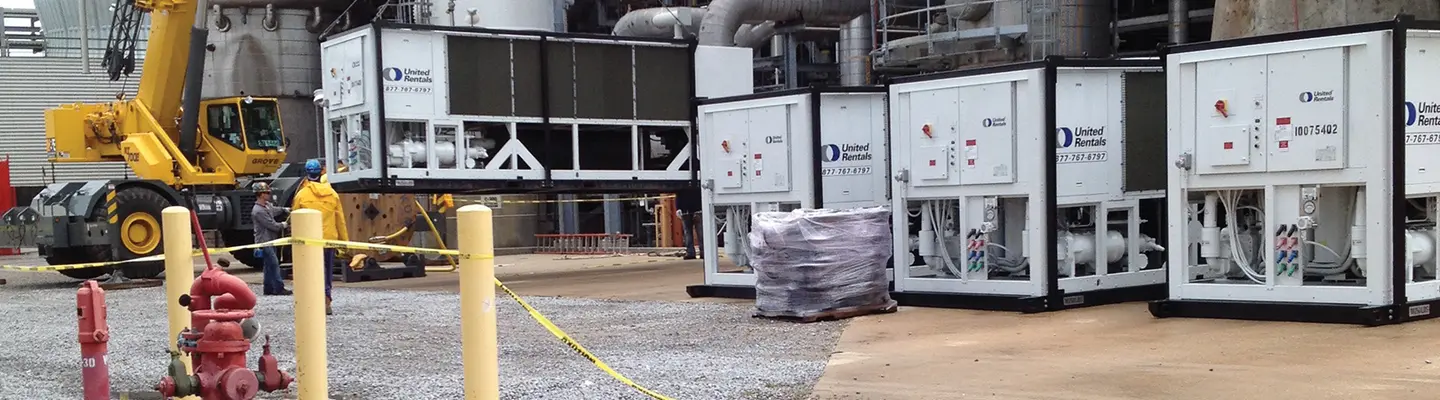
United Rentals’ Power and HVAC team will work with you to assess your space and review options from its large fleet of industrial air conditioners, portable air conditioners, air-cooled chillers and spot coolers.
Whether you need temporary cooling for a temperature-sensitive commercial space, a warehouse, your next large event or your home, United Rentals can help you discover equipment options and provide professional support.
 Facebook
 X
 Linkedin
 Email
 Print
 Copy Link
 RSS Feed